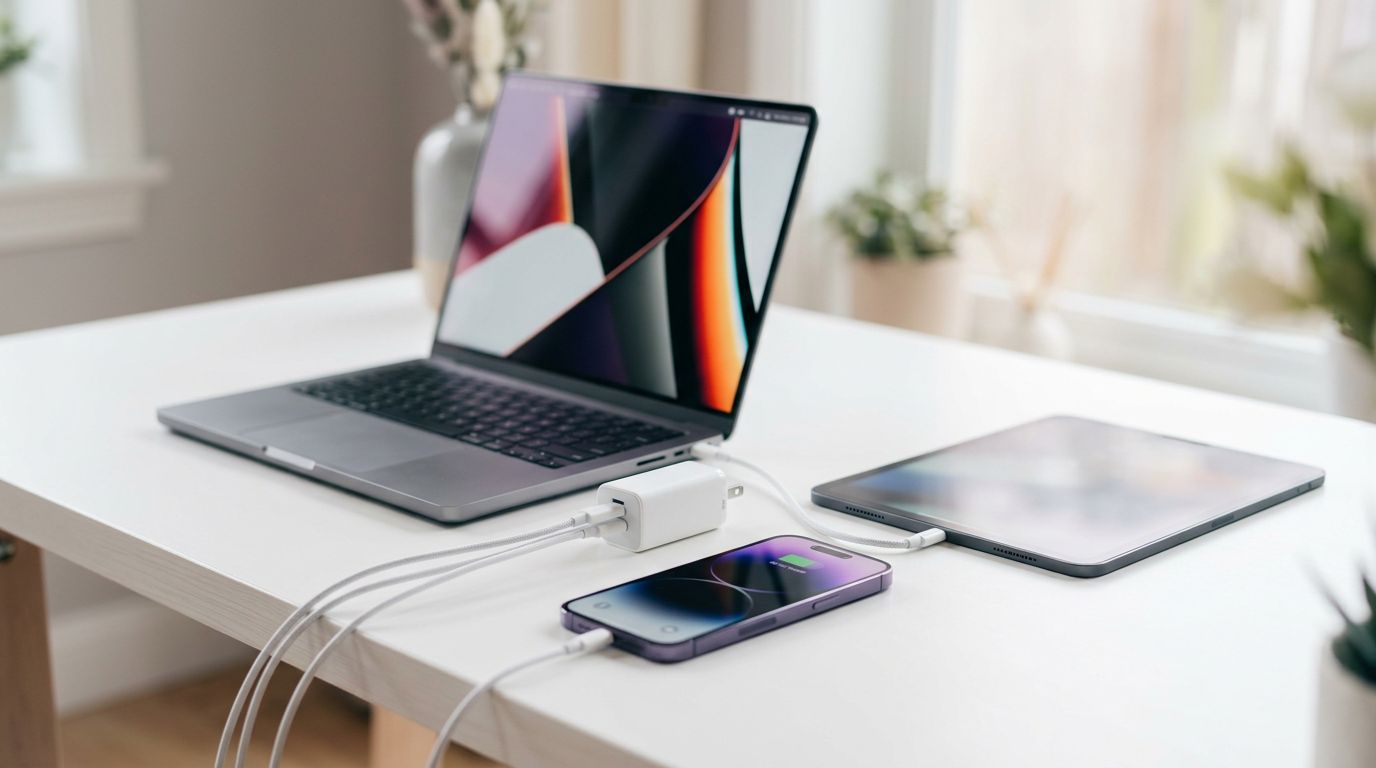
Carrying separate chargers for your iPhone 14 Pro, MacBook Pro, and iPad Pro feels like packing two toothbrushes. It works, but it’s annoying. A good 65W GaN charger fixes that with one compact brick that enables fast charging for your phone and comfortably powers your laptop.
Still, not every “65W” charger behaves the same. Some only hit 65W on a single port. Others split power in ways that slow everything down. In this guide, you’ll get clear selection criteria, realistic charging expectations, and a ranked set of picks that make sense for iPhone 14 Pro, MacBook Pro, and iPad Pro users in 2026.
GaN technology packs more power into smaller packages with better efficiency and less heat than silicon chargers. Start with charging protocol. For iPhone and MacBook Air, you want USB-C Power Delivery first, then everything else.
Next, watch the wattage details. A charger can say “65W” and still disappoint if that’s the combined total across ports.
Size and travel design matter more than people admit. A charger can be “small” yet awkward on a power strip.
Finally, take safety seriously. Look for clear labeling, reputable brands, and documented compliance marks (UL, ETL, CE, FCC) when available.
If you want broader context on how top GaN models are evaluated, ZDNET’s best GaN chargers list is a helpful reference point.
These are “65W class” GaN chargers (roughly 65 to 67W). Each one can serve as a one-charger setup, but they shine in different situations.
If you want one charger that feels effortless, this is the easy pick. It’s compact for its power as a great wall charger with 65W max output, and it gives you flexible ports as a 3-port charger for a laptop, phone, and a third device.
Pros
Cons
Expect your laptop wattage to dip when you add a second device. That’s normal behavior, not a defect.
This is for commuters and frequent travelers who care about shape as much as watts. The slim profile with portable design fits tight airport outlets and crowded hotel power strips better than a cube, making it an ideal travel charger for iPad Pro and Galaxy S22.
Pros
Cons
A desk setup benefits from more ports, even if you don’t always use them. This Nexode style is great for charging a MacBook Air, iPhone, and two smaller devices (watch, earbuds, keyboard) thanks to intelligent power allocation and a USB-A port for universal compatibility.
Pros
Cons
If you’re comparing the exact port layout and current revision, the product listing for UGREEN Nexode 65W 4-port charger is a practical place to confirm details.
Two USB-C ports is the sweet spot for many Apple users. One cable stays with the MacBook Air, the other stays with the iPhone. This 65W GaN charger is a reliable wall charger, and Belkin clearly positions this model with PPS protocol support for compatibility with iPhone 14 Pro and Galaxy S22.
Pros
Cons
Belkin’s product page for the Dual USB-C GaN wall charger with PPS 65W is useful if you want the official positioning and compatibility notes.
If you want a smaller spend, the usual move is choosing a charger with fewer premium extras while keeping the core specs. This 3-port charger model is a good one to compare against pricier three-port options, with a USB-A port and portable design.
Pros
Cons
You can review the current configuration on the INVZI GaNHub 65W product page.
Here’s a fast scan of the key differences you’ll feel day to day.
| Charger | 65W max output | Total watts | Port layout | PPS range | 2-device / 3-device charging | Plug type | Weight | Notable pros/cons |
|---|---|---|---|---|---|---|---|---|
| Anker Prime 67W GaN | 67W | 67W | 2 USB-C ports, 1 USB-A port | Not stated | Yes / Yes | Not stated | Not stated | Compact, flexible, can cost more |
| UGREEN Nexode Pro Ultra-Slim 65W | 65W | 65W | 2 USB-C ports, 1 USB-A port | Not stated | Yes / Yes | Foldable prongs | Not stated | Slim for travel, may block outlets |
| UGREEN Nexode 65W 4-Port | 65W | 65W | 3 USB-C ports, 1 USB-A port | Not stated | Yes / Yes | Not stated | Not stated | Great desk hub, stronger power splitting |
| Belkin BoostCharge Pro Dual USB-C 65W | 65W | 65W | 2 USB-C ports | Not stated (PPS supported) | Yes / No | Not stated | Not stated | Clean two-port setup, fewer total ports |
| INVZI GaNHub 65W (2C1A) | 65W | 65W | 2 USB-C ports, 1 USB-A port | Not stated | Yes / Yes | Not stated | Not stated | Good feature mix, confirm specs before purchase |
Note: These chargers offer universal compatibility with devices like the MacBook Pro, iPhone 14 Pro, and iPad Pro.
Takeaway: if you charge two things most of the time, a dual USB-C model feels simplest. If you charge three things often, pick a 3 or 4-port charger and accept power sharing.
A MacBook Air does not pull 65W all the time. In light use, it often draws much less. When the battery is low or the CPU is busy, like during video calls with external displays, it asks for more. A MacBook Pro or iPad Pro would demand even higher watts in similar high-demand scenarios. That’s why a 65W GaN charger feels “effortless,” even if your Air rarely needs the full number.
Multi-port charging changes the story. When you plug in a second device, the charger uses intelligent power allocation to divide a fixed budget. In practice, that means your MacBook Air may drop from “fast enough” to “still charging, just slower.”
Here’s an easy way to think about it: 65W is a pizza. One hungry laptop can eat most slices. Add an iPhone 14 Pro, and the laptop gets fewer slices.
Cable choice also matters more than people expect:
For added convenience, consider accessories that offer wireless charging as a complement to your wall charger. A MagSafe charger or one supporting Qi2 technology can keep devices like your iPhone powered up without extra cables.
Last, avoid sketchy listings and counterfeits, especially when picking up plug adapters for international travel. A charger is literally a tiny power plant next to your bed. Stick with reputable brands that provide universal compatibility, overheat protection, and QC 4.0 support; buy from known retailers, and don’t ignore heat, smell, or buzzing.
The best 65W GaN charger is the one that matches how you actually charge: two devices on the go, or three to four devices at a desk. Start by prioritizing PD support, predictable power sharing, universal compatibility, and trustworthy safety credentials. Then pick the wall charger form factor you’ll enjoy carrying for fast charging, because the “perfect” charger at home won’t help you in your bag.










Leave a comment